Enclosures, listed inside and out.
Three families, every size in millimetres, the IP figure exactly as the maker prints it. No drilling, no machining, no printed panels.
ABS wall boxes
screw-down lids, blank walls or moulded knock-outs
| Code | Outside | Inside | Lid fixing | Cable entry | IP as printed |
|---|---|---|---|---|---|
| AW-08 | 80 × 80 × 55 | 72 × 72 × 48 | four screws | blank walls | IP65 |
| AW-10 | 100 × 100 × 60 | 92 × 92 × 52 | four screws | blank walls | IP65 |
| AW-12 | 120 × 80 × 55 | 112 × 72 × 48 | four screws | blank walls | IP65 |
| AW-15 | 150 × 110 × 70 | 141 × 101 × 62 | four screws | knock-outs, two long sides | IP66 |
| AW-20 | 200 × 150 × 80 | 190 × 140 × 72 | four screws | knock-outs, two long sides | IP66 |
| AW-24 | 240 × 190 × 90 | 229 × 179 × 82 | four screws, hinged option | knock-outs, all four sides | IP66 |
| AW-30 | 300 × 230 × 110 | 288 × 218 × 100 | six screws, hinged option | knock-outs, all four sides | IP66 |
A wall box is bought by its inside. The outside figure tells you whether it fits the space on the wall; the inside figure tells you whether your board, your short length of rail and the bend radius of your cable fit in it, and that is the figure that decides. Both are on the sheet, and the difference between them is the wall thickness plus the stand-off of the lid, which on this family works out at four millimetres a side and seven or eight in depth.
Lids fix with four captive screws into brass inserts on the smaller sizes and six on the largest. A hinged lid is a separate code on the two biggest boxes and is listed on the quote as such. Lid and base are the same light grey; there is no clear lid in this family, and we do not carry one because the maker does not make one.
Cable entry is blank walls up to the 120 size and moulded knock-outs above it. A knock-out is a thinned ring in the wall that a gland nut breaks out cleanly, and it is the only sanctioned way a hole appears in a box we sell. A box with a knock-out removed and a gland fitted keeps the maker's IP figure only if the gland's own figure is as high; a drilled hole keeps nothing, and drilling is yours to do or not.
ABS rail-clip boxes
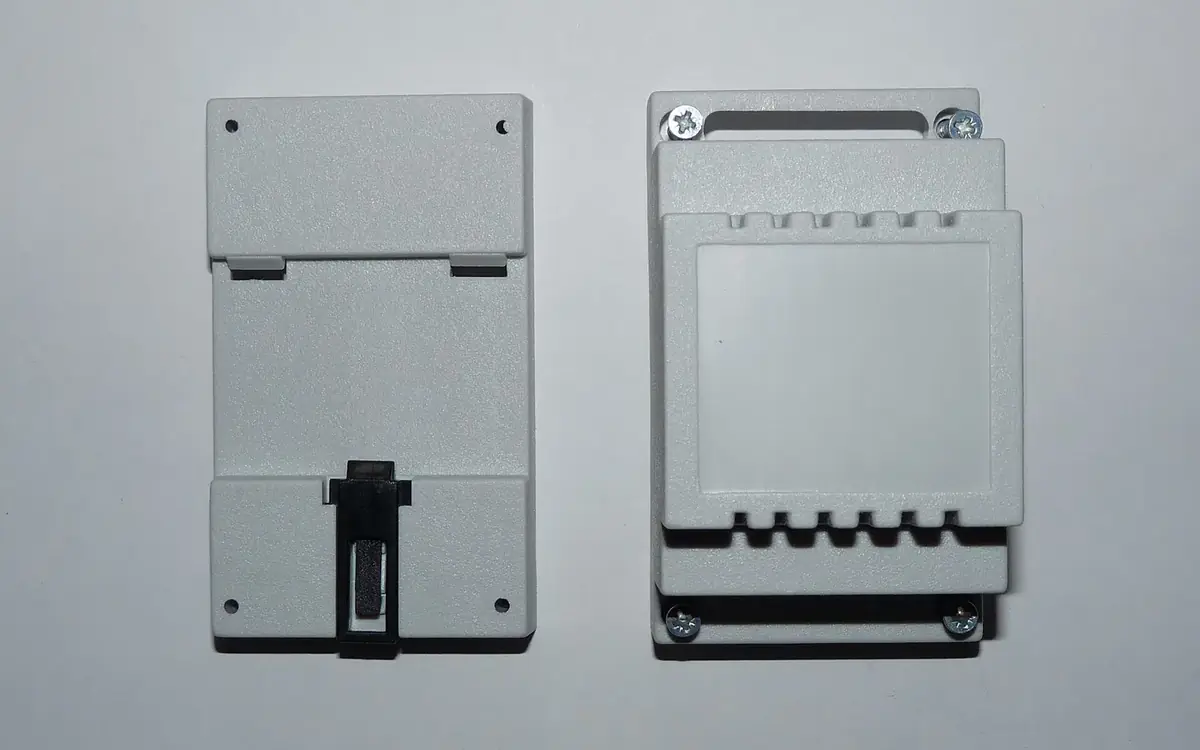
modular widths, snap lids, for inside a cabinet
| Code | Width on the rail | Front height | Depth from rail | Lid | IP as printed |
|---|---|---|---|---|---|
| AR-02 | 36 mm, two modules | 90 mm | 58 mm | snap, opaque or clear | IP20 |
| AR-04 | 71 mm, four modules | 90 mm | 58 mm | snap, opaque or clear | IP20 |
| AR-06 | 106 mm, six modules | 90 mm | 58 mm | snap, opaque or clear | IP20 |
| AR-09 | 158 mm, nine modules | 90 mm | 58 mm | snap, opaque | IP20 |
| AR-12 | 212 mm, twelve modules | 90 mm | 58 mm | snap, opaque | IP20 |
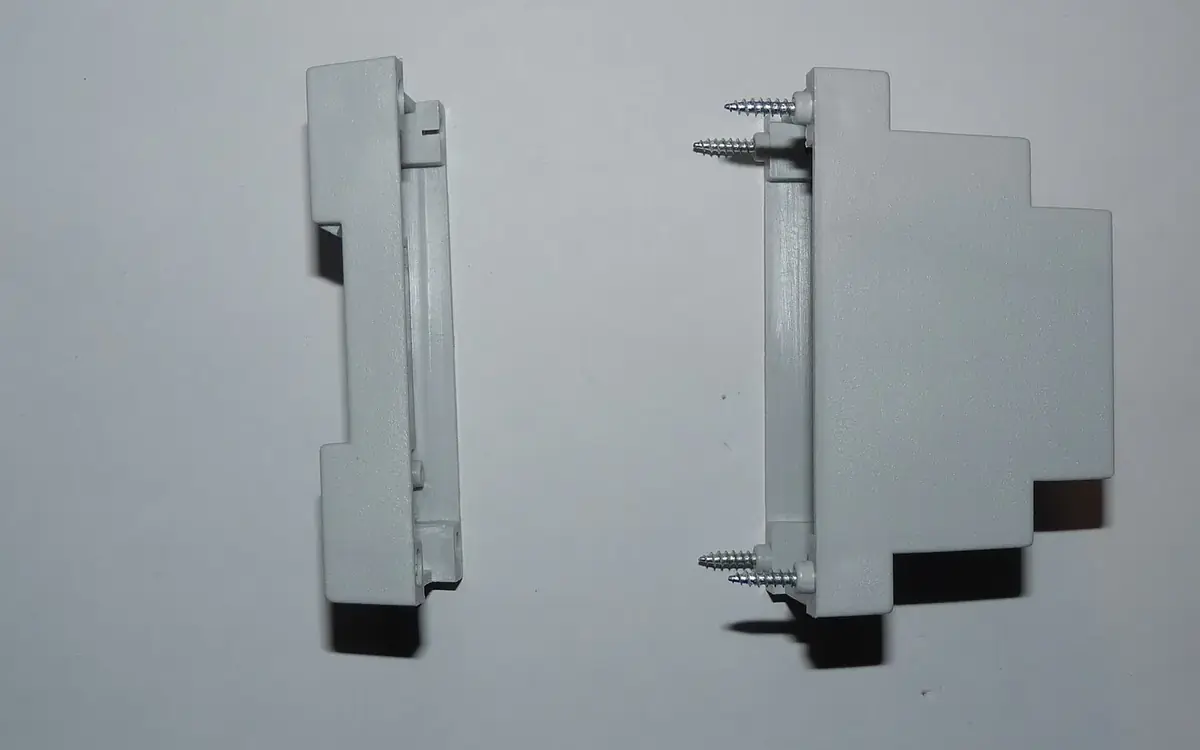
A rail-clip box hangs on the same 35 mm top-hat rail as a terminal block and takes up a whole number of modules, a module being 17.5 mm across. Two modules is a relay-sized housing; twelve is a small controller. The widths on the sheet are the maker's, rounded to the millimetre, and the 90 mm height is the standard height of the front for a cabinet with a cut-out cover, so the lid sits flush with the cover and the terminals sit behind it.
These boxes are IP20 by the maker's figure and are meant to live inside something else. The lid snaps on and pulls off without a tool; the base carries a spring clip that grips the rail and releases with a screwdriver. Terminal apertures are moulded top and bottom in the lid, in the pattern the maker chose, and we do not open, widen or close them.
Clear lids are carried on the three smallest sizes for boards with an indicator that has to be read; on the two larger sizes the maker offers opaque only, and the sheet says so rather than leaving it to a footnote.
Aluminium die-cast boxes
heavier, gasketed, plain or black
| Code | Outside | Inside | Lid fixing | Finish | IP as printed |
|---|---|---|---|---|---|
| AD-05 | 50 × 45 × 30 | 45 × 40 × 26 | four screws | plain | IP65 |
| AD-09 | 90 × 36 × 30 | 84 × 30 × 26 | four screws | plain | IP65 |
| AD-11 | 115 × 65 × 55 | 108 × 58 × 50 | four screws | plain or black | IP66 |
| AD-16 | 160 × 100 × 60 | 152 × 92 × 55 | four screws | plain or black | IP66 |
| AD-22 | 222 × 146 × 55 | 214 × 138 × 50 | four screws | plain or black | IP67 |
| AD-26 | 260 × 160 × 90 | 250 × 150 × 84 | six screws | plain or black | IP67 |
Die-cast aluminium is chosen for two things ABS cannot give: a wall you can tap a thread into, and a lid that sits on a gasket in a machined groove. The gasket is what carries the maker's IP figure; the sheet quotes IP65 on the two small sizes and IP66 or IP67 on the rest, and those are the maker's numbers for the box as supplied, lid screwed down, gasket untouched.
The plain finish is the casting as it comes, lightly tumbled. Black is a powder coat over the same casting and adds under half a millimetre to every outside figure, which is why the outside column is written for the plain box. Inside dimensions are the same for both.
Every one of these is a workshop's box to drill, and we say plainly that we are not that workshop. Boxes leave here unmarked and unmachined, five to a carton, with the maker's gasket in the lid and the maker's screws in a bag.
Cable entry and the small parts
glands, grommets, ferrules, labels
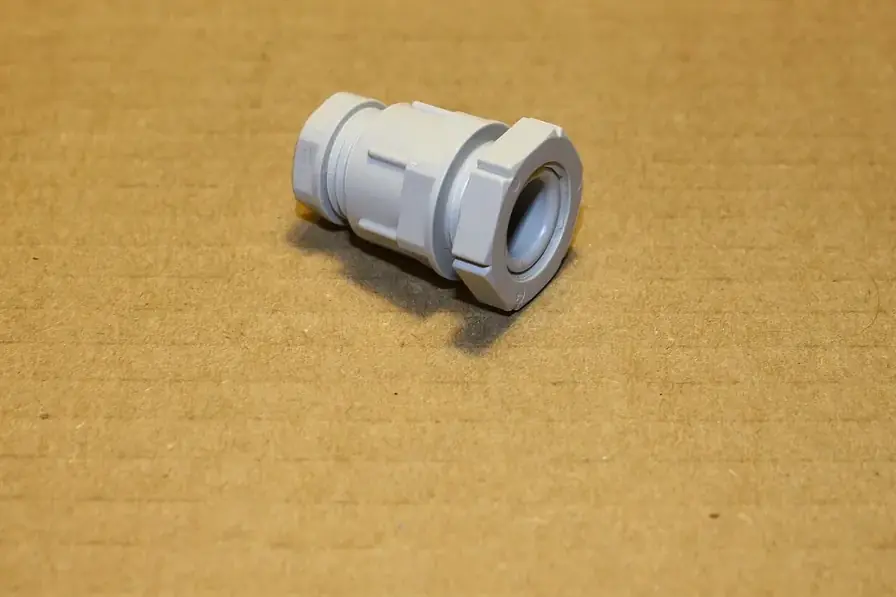
A gland is listed by its thread and the cable range it clamps: M12 for cable of three to six and a half millimetres, up through M40 for cable to 32 mm. Nylon glands with a nitrile seal are the stock line, in grey and black, with a lock nut in the bag. Each carries the maker's own IP68 figure for the gland; whether the box around it stays at its figure depends on the hole, and the hole is never ours.
Grommets are sold by the hole they fit, from 6 to 30 mm, open or blind. Ferrules are tinned copper with an insulated collar, by wire cross-section from 0.25 to 16 mm², in bags of a hundred; twin ferrules for two conductors in one clamp are carried in the four commonest sizes. Blank self-adhesive labels come by the sheet, and pre-printed marker strips for rail blocks are on the DIN-rail page because they belong with the blocks.
What we will not do to an enclosure
- Drill, punch, mill or cut any wall, lid or front
- Print, engrave or label a panel
- Fit glands, rail or anything else inside a box before it ships
- Re-state, test or improve on the maker's IP figure
Send the internal dimensions you need and the cable count going in, and the quote names the family, the code and the box quantity. Ask for a price on a part.